
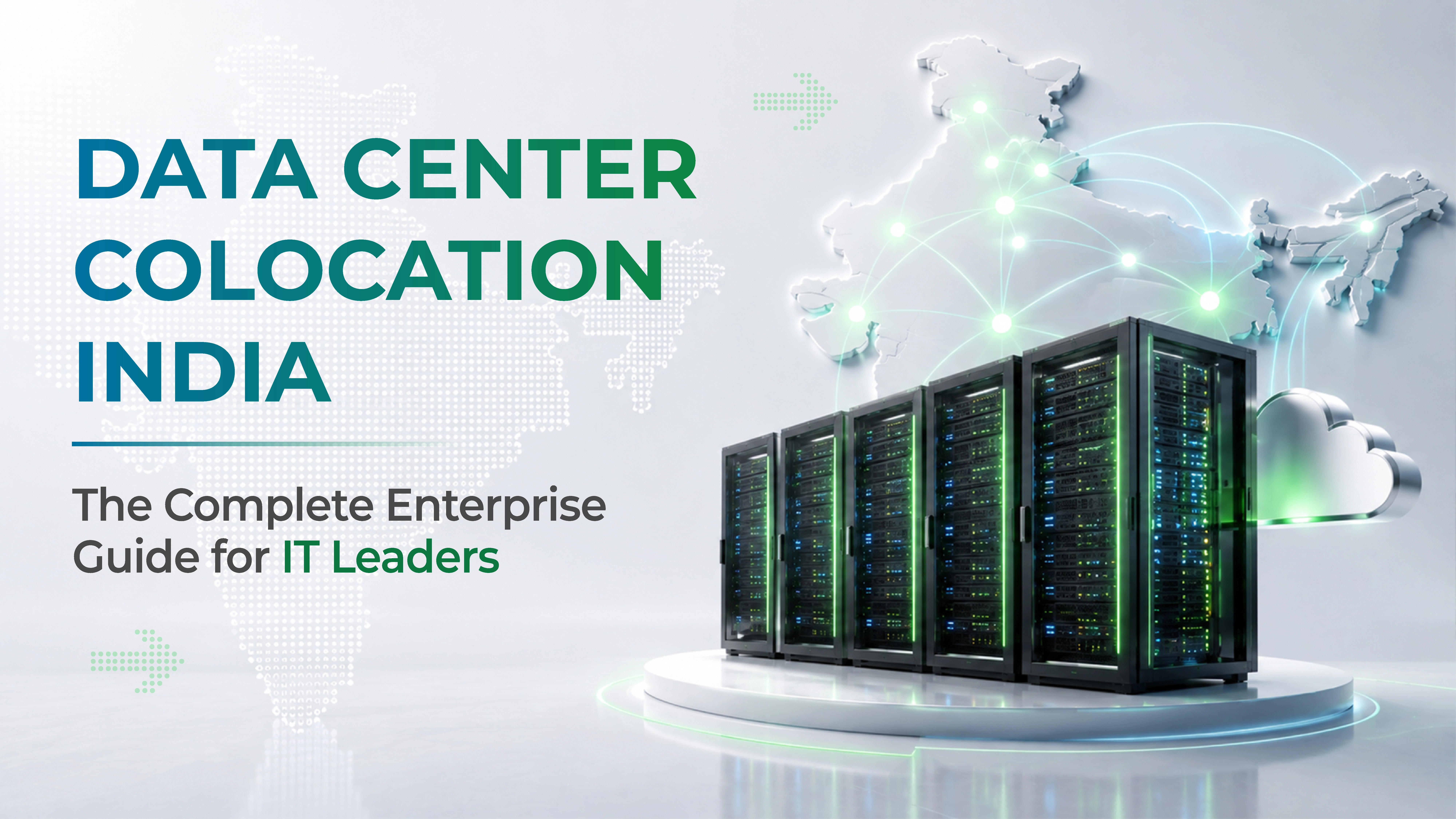
Indian enterprises are moving fast, and their infrastructure has to keep up. Data center colocation in India has shifted from a cost-saving tactic to a strategic foundation for companies that need reliable, scalable, and compliant IT infrastructure without the capital expenditure of building their own facilities.
Whether you're a CTO planning a multi-year infrastructure roadmap or an IT manager evaluating options for the next fiscal cycle, this guide covers everything you need to make an informed decision.
What Is Enterprise Colocation and Why India?
Enterprise colocation means housing your servers, networking gear, and storage within a third-party facility that rents physical space, power, and cooling rather than building it yourself. You retain full ownership and management of your hardware. The data center handles the physical infrastructure.
India's digital economy is one of the fastest-growing in the world. That growth is pulling enterprise colocation services into the spotlight because internal data center builds are expensive, slow, and increasingly difficult to justify when third-party facilities offer Tier III or Tier IV standards at a fraction of the capital outlay. The country now hosts major colocation hubs across Mumbai, Chennai, Hyderabad, Pune, and Bengaluru, each with its own connectivity profile and disaster-risk characteristics.
The decision isn't simply about cost. It's about velocity. A company that can spin up compute capacity in a certified colocation environment in weeks rather than years holds a structural advantage over competitors still waiting on construction timelines.
Key Infrastructure Standards to Evaluate
Not all colocation facilities are equivalent, and the gap between a Tier II and a Tier IV facility is not academic.
Uptime Institute Tier certifications are the industry benchmark. Tier III facilities offer 99.982% availability with N+1 redundancy across power and cooling, which is acceptable for most enterprise workloads. Tier IV goes further, offering 99.995% availability with fault-tolerant, concurrently maintainable systems. For mission-critical applications like financial trading platforms, healthcare records, or payment processing, Tier IV is not a luxury.
Power density matters more than it used to. Modern GPU-heavy workloads and AI inference infrastructure can demand 20–30 kW per rack, far more than the 3–5 kW older facilities were designed around. Before signing any colocation agreement, confirm the facility's per-rack power capacity and cooling architecture, such as air-cooled, liquid-cooled, or hybrid.
Physical security deserves the same rigor as your network security posture. Look for biometric access controls, 24/7 CCTV with retention policies, man-trap entry systems, and on-site security personnel. These aren't optional features. They're table stakes.
Data Center Colocation India: Connectivity and Carrier Diversity
Connectivity is where many colocation decisions are quietly won or lost.
A world-class facility with subpar carrier access is a liability. The best data center colocation India providers maintain carrier-neutral environments with direct access to multiple Tier 1 internet service providers, submarine cable landing stations, and internet exchange points.
Carrier neutrality is non-negotiable for enterprises with serious latency requirements. Being locked to a single ISP inside a colocation facility removes your ability to engineer redundancy at the network layer. And network redundancy is where SLA uptime commitments are either kept or broken.
Low-latency cross-connects between your colocation environment and major cloud platforms are now a baseline expectation, not a premium add-on. Direct cloud on-ramps reduce latency by 30–60% compared to public internet paths and offer more predictable throughput.
Compliance, Data Sovereignty, and Regulatory Landscape
India's regulatory environment for data handling has matured significantly, and compliance is no longer something enterprises can treat as an afterthought.
The Digital Personal Data Protection Act (DPDPA) establishes clear obligations around data localization and processing consent. Enterprises in regulated sectors such as banking (RBI guidelines), healthcare (DISHA framework), and telecommunications face additional layer-specific compliance requirements that directly affect where and how data can be stored. Colocation in India provides a path to meeting these obligations without building proprietary infrastructure.
However, data sovereignty requirements do not eliminate cloud usage. Instead, they influence how enterprises design their infrastructure. Many enterprises are moving toward a hybrid posture where regulated data sits in domestic colocation environments, while less-sensitive workloads run on global cloud platforms. That's the architecture that actually satisfies both the compliance team and the engineering team.
ISO 27001 certification and SOC 2 Type II attestation from your colocation provider are necessary signals of operational maturity. Verify they're current, not historical.
Total Cost of Ownership: What the Numbers Actually Look Like
Colocation is cheaper than building your own data center for enterprises below a certain scale.
A full private data center build in India, including land acquisition, construction, power provisioning, and compliance certification, runs anywhere from ₹50 crore to ₹300 crore depending on tier and location. Enterprise colocation services, by contrast, can be provisioned with a capital outlay close to zero and monthly operational costs scaled to actual consumption.
That said, total cost of ownership analysis should include exit costs, cross-connect fees, power redundancy premiums, and remote hands charges all of which can add 15–25% to headline rack rental prices. Read the contract carefully. Providers vary widely in how they structure these charges, and a low base rate can become an expensive surprise in year two.
Data Center Colocation India: Choosing the Right Provider
The selection criteria matter more than the selection process. Most enterprise IT teams do a reasonable job of running an RFP, but they ask the wrong questions.
Uptime track record, not just Tier certification, is the real indicator. Ask for historic incident reports. Ask about the last unplanned outage, what caused it, and what changed afterward. Any provider unwilling to answer that question is telling you something important.
Geographic redundancy within India is worth considering for enterprises with genuine disaster-recovery obligations. For example, having colocation presence in both Mumbai and Hyderabad places infrastructure in different seismic zones with separate power-grid exposure. That's real resilience engineering.
Scalability timelines are frequently underestimated. Confirm that your provider can deliver additional rack space or power capacity within a defined timeframe, not "subject to availability." Fast-growing enterprises get burned by colocation agreements that can't keep pace.
Why Slivernox Stands Apart
Slivernox has built its reputation on something that's harder to replicate than infrastructure specs: operational consistency at scale, with a customer-facing team that understands enterprise requirements before they become emergencies.
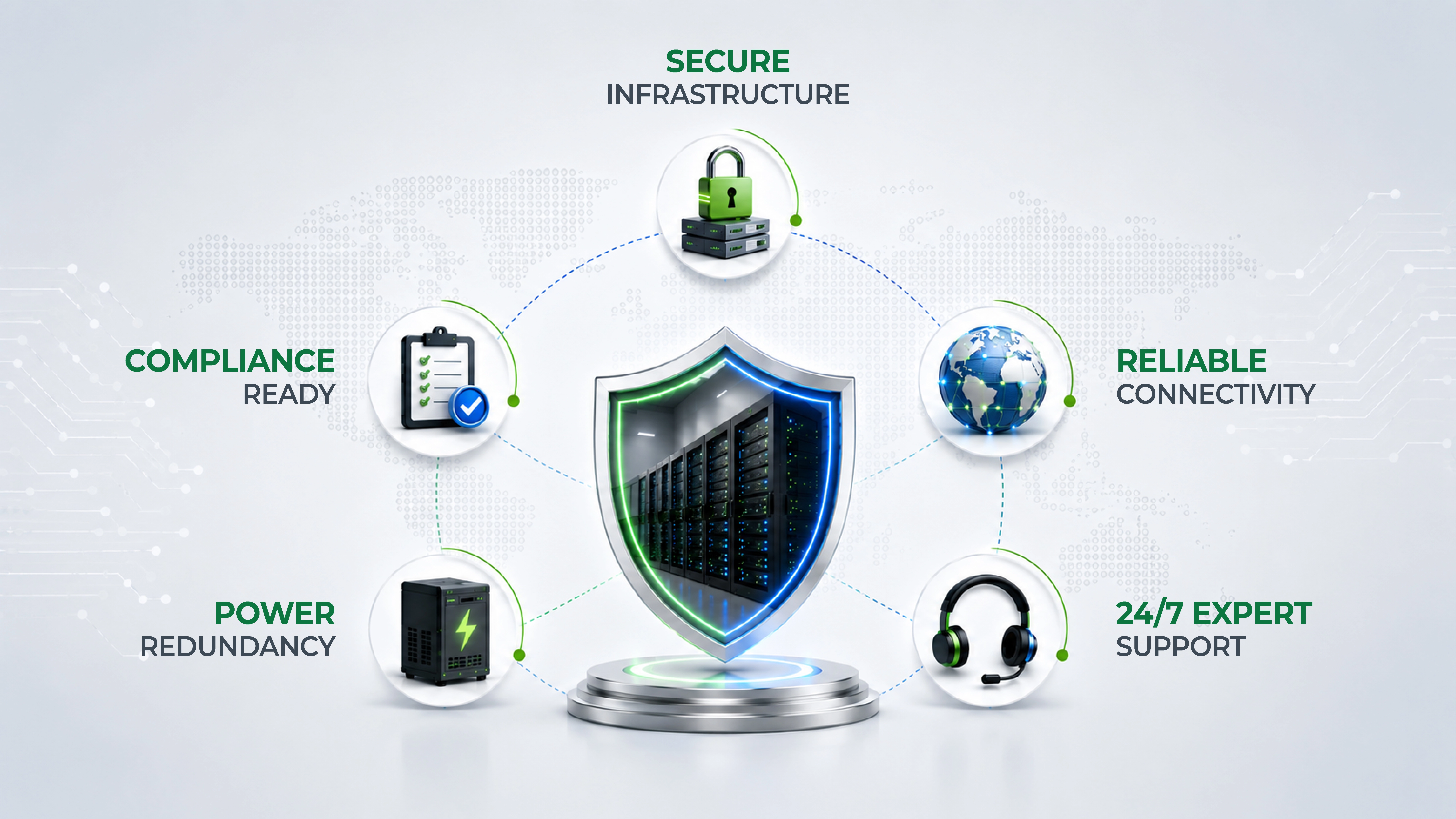
The Slivernox colocation environment delivers carrier-neutral connectivity, Tier III-compliant infrastructure, and 24/7 remote hands support across facilities positioned to serve India's major commercial and technology corridors. The architecture is designed for enterprises running mixed workloads: traditional on-premise servers sitting alongside high-density compute nodes, with direct cloud on-ramps to major hyperscalers.
What separates Slivernox from generic enterprise colocation services is the engagement model. Account teams are technically staffed, not just commercially. When an IT manager calls at 2 AM because a network card failed, the response is a solution, not a ticket number. That operational philosophy is embedded in their SLA structure with measurable commitments on response time, resolution time, and power availability.
For CTOs mapping out a three-to-five-year infrastructure posture that balances performance, compliance, and cost, Slivernox offers a partner relationship that turns colocation from a vendor transaction into a strategic advantage.
If you're ready to evaluate how Slivernox's colocation facilities can support your enterprise infrastructure goals, reach out to their technical team for a site walkthrough and a customized capacity assessment. The conversation costs nothing and clarifies a great deal.
Frequently Asked Questions
What is data center colocation in India and how does it differ from cloud hosting?
Colocation means placing your own physical servers and networking equipment inside a third-party data center, where you pay for space, power, and cooling. Cloud hosting, by contrast, means renting virtualized compute resources on hardware you never own or touch. Colocation gives you full hardware control and typically delivers more predictable performance for latency-sensitive workloads, while cloud offers faster elasticity and no capital expenditure on hardware.
Which cities in India are the most established hubs for enterprise colocation?
Mumbai leads in terms of submarine cable connectivity and carrier density, making it the default choice for enterprises with high international traffic volumes. Hyderabad and Bengaluru have grown rapidly as technology corridor hubs with strong domestic carrier access. Chennai offers proximity to South India's industrial base and additional submarine cable landing points. The right location depends on your customer geography, disaster recovery requirements, and proximity to cloud regions.
How do I evaluate whether a colocation provider meets compliance requirements under India's data protection laws?
Start by confirming whether the facility is covered under your sector-specific regulatory framework — RBI, SEBI, or DISHA guidelines each carry different requirements. Ask the provider for their current ISO 27001 certificate and any SOC 2 Type II reports, and verify the issuance dates. Review their data processing agreements for provisions around data access, incident notification timelines, and subprocessor disclosure — these are the clauses that matter most during a regulatory audit.
What happens if my colocation provider experiences a major power outage?
Tier III and Tier IV facilities maintain redundant power paths, uninterruptible power supplies, and diesel generators sized to sustain full load for 48–72 hours or more. In the event of a grid failure, automatic transfer switches activate backup power within milliseconds; customers typically experience zero interruption. The risk of extended outage comes from cascading failures across cooling, power, and network simultaneously, which is why reviewing a provider's historical incident log is more informative than their SLA document.
What is the typical contract length and minimum commitment for enterprise colocation in India?
Most enterprise colocation agreements run one to three years, with three-year terms offering meaningfully better pricing typically 10–20% lower monthly rates compared to month-to-month arrangements. Minimum commitments vary: some providers start at a single rack unit, while others require a quarter-rack or half-rack minimum for enterprise-grade SLAs. Larger deployments (10+ cabinets) usually trigger dedicated account management and negotiable power and connectivity packages.
Is enterprise colocation more cost-effective than running an on-premise server room?
For most mid-to-large enterprises, colocation is significantly more cost-effective than maintaining an on-premise server room once you factor in redundant power infrastructure, cooling systems, physical security, and round-the-clock staffing. The tipping point sits roughly at the scale where an enterprise would need to invest heavily in infrastructure upgrades to meet modern uptime or compliance standards; at that point, colocation almost always wins on total cost of ownership over a five-year horizon.
How long does it take to deploy infrastructure in a colocation facility in India?
A standard colocation deployment racking your equipment, establishing cross-connects, and completing network configuration typically takes two to four weeks from contract signing to live traffic. Complex deployments involving high-density power, dedicated fiber circuits, or direct cloud on-ramps may extend the timeline to six to eight weeks. Providers with pre-provisioned capacity and a structured onboarding process consistently deliver faster time-to-operation than those handling each deployment ad hoc.